
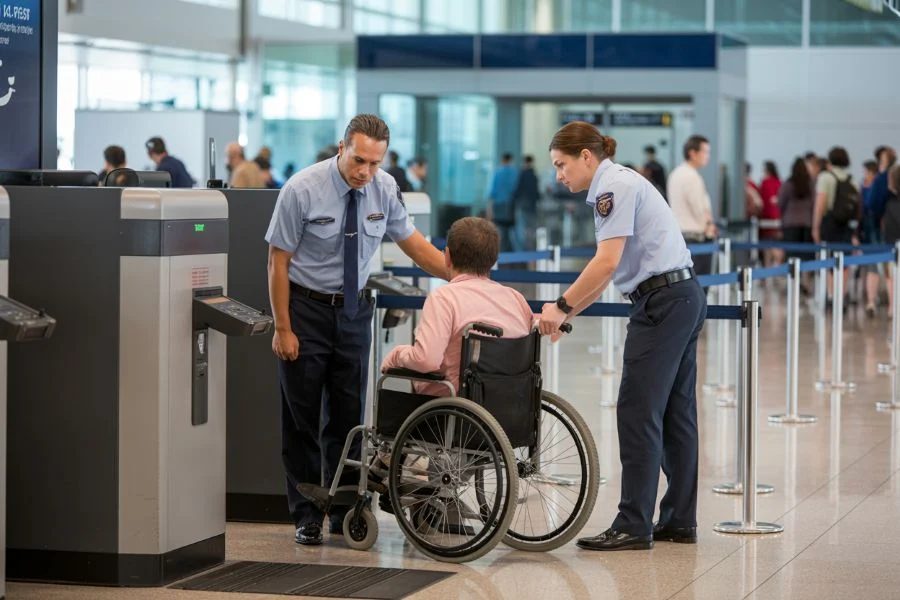
Wheelchair user Elena Hoffmann had just finished a grueling 12-hour flight from Bangkok when she faced what she dreaded most: navigating Munich Airport’s security checkpoint. “Every time I travel, this is the part that makes me anxious,” she confided to her travel companion as they approached Terminal 2. “Will I have to transfer out of my chair? How long will this take?”

But this time was different. Elena was about to become one of the first passengers to experience something revolutionary – Germany’s first completely barrier-free security checkpoint, designed specifically with accessibility in mind.
What happened next surprised her. Instead of the usual complicated transfer process, Elena rolled straight through specialized equipment that scanned her and her wheelchair simultaneously. “I couldn’t believe it,” she said later. “For the first time in twenty years of traveling, I felt like just another passenger.”

Munich Airport Makes History with Groundbreaking Accessibility Innovation
Munich Airport’s Terminal 2 has officially launched Germany’s first barrier-free security checkpoint, marking a significant milestone in accessible travel. This isn’t just another airport upgrade – it’s a complete reimagining of how security screening can work for passengers with mobility challenges.
The new checkpoint eliminates the need for wheelchair users to transfer to airport-provided chairs or undergo separate screening procedures. Instead, cutting-edge technology allows passengers to remain in their personal mobility devices throughout the entire security process.

This represents a fundamental shift in how we approach airport security. We’re not just accommodating passengers with disabilities – we’re creating an experience that’s dignified and efficient for everyone.
— Dr. Marcus Weber, Munich Airport Accessibility Director

The technology behind this breakthrough includes advanced imaging systems that can distinguish between mobility devices and potential security threats, while specialized conveyor systems accommodate different wheelchair sizes and weights.
What Makes This Security Checkpoint Revolutionary
The barrier-free checkpoint incorporates several innovative features that set it apart from traditional security screening:

- Wheelchair-accessible scanner: Passengers remain in their own mobility devices throughout screening
- Adjustable conveyor belts: Accommodate different heights and reach capabilities
- Enhanced imaging technology: Distinguishes between medical devices and security threats
- Specialized staff training: Security personnel trained in disability awareness and assistance techniques
- Streamlined process: Reduces screening time by up to 70% for mobility device users
- Privacy protection: Maintains dignity throughout the security process
Here’s how the new system compares to traditional security checkpoints:
| Feature | Traditional Checkpoint | Barrier-Free Checkpoint |
|---|---|---|
| Transfer Required | Yes, to airport chair | No, stay in personal device |
| Average Processing Time | 15-25 minutes | 5-8 minutes |
| Privacy Level | Limited | Full privacy maintained |
| Staff Training | Basic | Specialized accessibility training |
| Medical Device Screening | Manual inspection | Advanced automated scanning |
The difference is night and day. What used to be a stressful, time-consuming ordeal is now smoother than regular passenger screening.
— Jennifer Walsh, Disability Rights Advocate
Who Benefits and How This Changes Air Travel
While wheelchair users are the primary beneficiaries, the new checkpoint serves a much broader population than you might expect. Anyone using mobility devices – from temporary crutches to powered scooters – can utilize this barrier-free screening.
The numbers are staggering. According to recent statistics, over 2.7 million Germans use wheelchairs or mobility aids, and millions more travel through Munich Airport annually with temporary mobility challenges from injuries or age-related needs.
Parents pushing strollers also benefit from the accessible design, as do elderly passengers who struggle with traditional security procedures. The checkpoint’s design philosophy centers on universal accessibility – making travel easier for everyone, not just those with obvious disabilities.
We’re seeing families choose Munich specifically because of this checkpoint. Parents with special needs children know they’ll have a stress-free experience here.
— Thomas Richter, Munich Airport Customer Experience Manager
The ripple effects extend beyond individual passengers. Airlines report increased satisfaction scores from passengers using the barrier-free checkpoint, and the reduced processing time helps minimize flight delays caused by lengthy security procedures.
What This Means for the Future of Air Travel
Munich’s barrier-free checkpoint isn’t just a local innovation – it’s setting a new standard that other airports worldwide are already studying. The European Union has expressed interest in making similar technology mandatory across member nations by 2027.
The economic impact is equally significant. Accessible travel is a growing market segment worth over €8 billion annually in Europe alone. Airports that fail to adapt risk losing substantial revenue as travelers increasingly choose destinations based on accessibility features.
For travelers planning future trips, this development signals a broader shift toward inclusive travel infrastructure. Munich Airport officials report that Terminal 1 will receive similar upgrades by late 2024, with plans for additional accessibility improvements throughout the facility.
This is just the beginning. We’re proving that accessibility and efficiency aren’t mutually exclusive – they actually enhance each other.
— Dr. Sarah Lindemann, International Air Transport Association
The technology itself is becoming more affordable and easier to implement, meaning smaller airports can adopt similar systems without massive infrastructure overhauls.
Planning Your Trip Through Munich’s New Checkpoint
If you’re planning to use Munich Airport’s barrier-free checkpoint, here’s what you need to know. The checkpoint operates during all Terminal 2 hours, with specially trained staff available to assist with any questions or concerns.
Advance notification isn’t required, but Munich Airport recommends contacting their accessibility services team for complex medical devices or if you need additional assistance. The checkpoint handles all types of mobility devices, from manual wheelchairs to complex powered systems.
International travelers should note that while the checkpoint streamlines security screening, all standard security regulations still apply. The difference is in how those regulations are implemented – with dignity and efficiency taking priority.
FAQs
Do I need to make advance reservations to use the barrier-free checkpoint?
No reservations are required, though contacting Munich Airport’s accessibility services can help ensure the smoothest experience for complex medical equipment.
How much time should I allow for security screening?
Most passengers complete screening in 5-8 minutes, significantly faster than traditional checkpoints that can take 15-25 minutes for mobility device users.
Can family members accompany me through the barrier-free checkpoint?
Yes, one companion can accompany passengers who need assistance, and families with young children can use the checkpoint together.
Does this checkpoint handle all types of mobility devices?
The checkpoint accommodates manual wheelchairs, powered wheelchairs, scooters, walkers, and other mobility aids of various sizes.
Are there any restrictions on medical devices or equipment?
Standard security regulations apply, but the advanced scanning technology can process most medical devices without requiring removal or manual inspection.
Will other airports adopt this technology?
Munich’s success is driving interest from airports worldwide, with several European airports planning similar installations by 2025.
Leave a Reply