
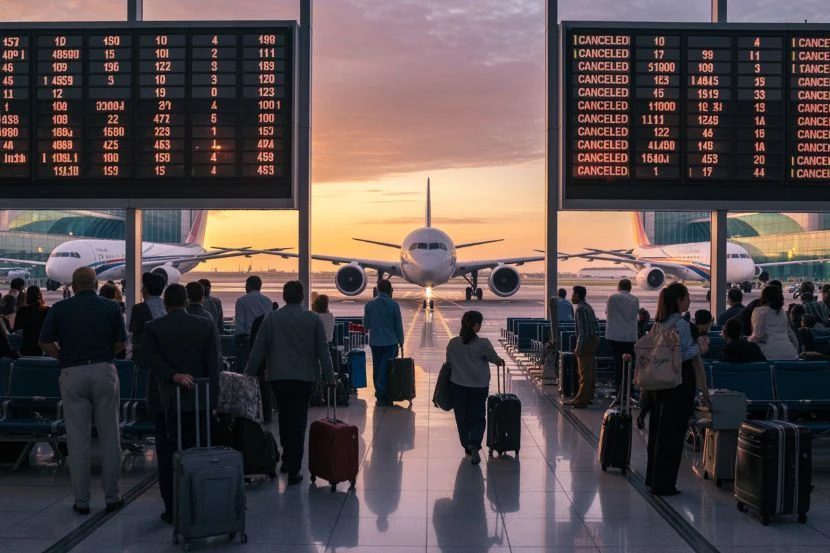
Priya Nakamura had been looking forward to her business trip to Dubai for weeks. Standing in Cairo International Airport at 3 AM, clutching her boarding pass and watching the departure board flash “CANCELLED” in red letters, she felt her stomach drop. Around her, dozens of other passengers were having heated phone conversations with their hotels, their bosses, their families.

“I’ve never seen anything like this,” she whispered to another stranded traveler. “Every flight to the Gulf seems to be grounded.”
Priya wasn’t alone. Across four major Middle Eastern hubs, thousands of travelers found themselves in the same nightmare scenario as airlines scrambled to manage one of the region’s most significant airspace disruptions in recent memory.

What’s Really Happening With Middle East Flights Right Now
The numbers tell a stark story: 54 flights completely cancelled and 61 more significantly delayed across major carriers including EgyptAir, Etihad Airways, and Saudia. The disruption has created a domino effect stretching from Cairo to Dubai, Abu Dhabi to Riyadh, with ripple effects reaching deep into Asian routes.
This isn’t just another weather delay or technical glitch. The scale of these cancellations suggests something much more complex is at play in Middle Eastern and Asian airspace management.

The coordination required to manage airspace across multiple countries is incredibly complex. When one major route gets disrupted, it can cascade across the entire regional network within hours.
— Captain Ahmed Hassan, Aviation Operations Specialist

The affected routes represent some of the busiest corridors in international travel, connecting Europe, Africa, and Asia through the Middle East’s major aviation hubs. These aren’t just vacation flights – they’re critical business routes, family connections, and cargo lifelines.
Which Routes Are Hit Hardest and What Travelers Need to Know
The impact varies dramatically depending on your departure city and final destination. Here’s what we know about the most affected routes:

| Airline | Hub Affected | Cancelled Flights | Delayed Flights | Primary Routes Impacted |
|---|---|---|---|---|
| EgyptAir | Cairo | 18 | 23 | Cairo-Dubai, Cairo-Riyadh, Cairo-Kuwait |
| Etihad Airways | Abu Dhabi | 21 | 19 | Abu Dhabi-Bangkok, Abu Dhabi-Mumbai, Abu Dhabi-London |
| Saudia | Riyadh | 15 | 19 | Riyadh-Jakarta, Riyadh-Manila, Riyadh-Karachi |
The most severely impacted passengers are those traveling on connecting flights through these hubs. If you’re flying from London to Bangkok via Abu Dhabi, or from New York to Mumbai through Dubai, you’re likely facing significant delays or complete rebooking.
- Business travelers heading to major conferences in Dubai and Riyadh are scrambling for alternative routes
- Pilgrimage travelers to Saudi Arabia are experiencing particular hardship with limited rebooking options
- Cargo flights carrying time-sensitive goods are backing up at European airports
- Oil industry personnel rotating to offshore platforms face potential contract delays
We’re seeing passengers who’ve been rerouted three times already. Some are choosing to drive between cities rather than wait for the next available flight.
— Fatima Al-Rashid, Travel Agent, Dubai International Airport
The Real Cost of Airspace Disruptions Goes Beyond Delayed Vacations
While cancelled flights are frustrating for any traveler, the broader implications of this disruption extend far beyond individual inconvenience. The Middle East serves as a critical aviation bridge between continents, and when that bridge gets shaky, the effects ripple globally.
Consider the cargo implications alone. Medical supplies heading to hospitals in Southeast Asia, automotive parts destined for manufacturing plants in India, and fresh produce bound for European markets – all sitting in warehouses instead of reaching their destinations.
For business travelers, missed meetings in Dubai’s financial district or Riyadh’s oil sector can translate into delayed contracts worth millions. The region’s position as a global business hub means that flight disruptions here don’t just affect tourism – they impact international commerce.
Every hour of delay in this region affects supply chains across three continents. We’re not just talking about passenger inconvenience – this hits the global economy.
— Dr. Rashid Khalil, International Trade Logistics Expert
Airlines are working around the clock to manage rebookings, but the challenge is immense. Alternative routes often require additional fuel stops, increasing both cost and travel time. Some passengers are looking at journey times that are double their original estimates.
What Airlines Are Telling Passengers and What You Should Actually Do
Official airline communications have been cautiously optimistic, with most carriers promising “minimal additional delays” and “full resolution within 48-72 hours.” However, industry insiders suggest the reality may be more complicated.
The airlines are offering standard rebooking policies, but with such widespread disruption, finding available seats on alternative flights is proving challenging. Many passengers are being offered flights that depart several days later than originally planned.
- Check your airline’s app every few hours – flight statuses are changing rapidly
- Consider alternative hubs – routes through Istanbul, Doha, or even European cities might be faster
- Document all expenses – meals, hotels, and ground transport may be reimbursable
- Contact your travel insurance provider immediately if you have coverage
The passengers who are handling this best are those who immediately started looking at completely different routing options rather than waiting for their original flights to resume.
— Marcus Thompson, International Travel Consultant
For travelers with flexible schedules, this might actually present an opportunity to explore alternative destinations or extend stays in current locations. However, for those with time-sensitive commitments, the situation requires immediate action and creative problem-solving.
The aviation industry’s interconnected nature means that disruptions like this can take days or even weeks to fully resolve, even after the initial problem is addressed. Passengers should prepare for continued irregularities in scheduling and be ready to adapt their travel plans accordingly.
FAQs
How long are these flight disruptions expected to last?
Airlines are estimating 48-72 hours for full resolution, but industry experts suggest passengers should prepare for delays extending beyond this timeframe.
Will I be compensated for additional expenses due to cancellations?
Compensation depends on your airline’s policy and the specific reason for cancellation. Keep all receipts for meals, accommodation, and transportation.
Should I book a different route through Europe instead?
If your travel is time-sensitive, alternative routes through Istanbul, Frankfurt, or London might get you to your destination faster, though at potentially higher cost.
Are connecting flights through these hubs also affected?
Yes, connecting flights are experiencing significant disruption. Passengers with tight connections should expect missed flights and extended layovers.
What should I do if I’m already at the airport?
Stay near your gate for updates, keep your phone charged, and consider rebooking immediately rather than waiting for your original flight to resume.
Are cargo and freight shipments also delayed?
Yes, cargo flights are experiencing similar disruptions, which may affect delivery times for packages and commercial shipments across multiple continents.

Leave a Reply