
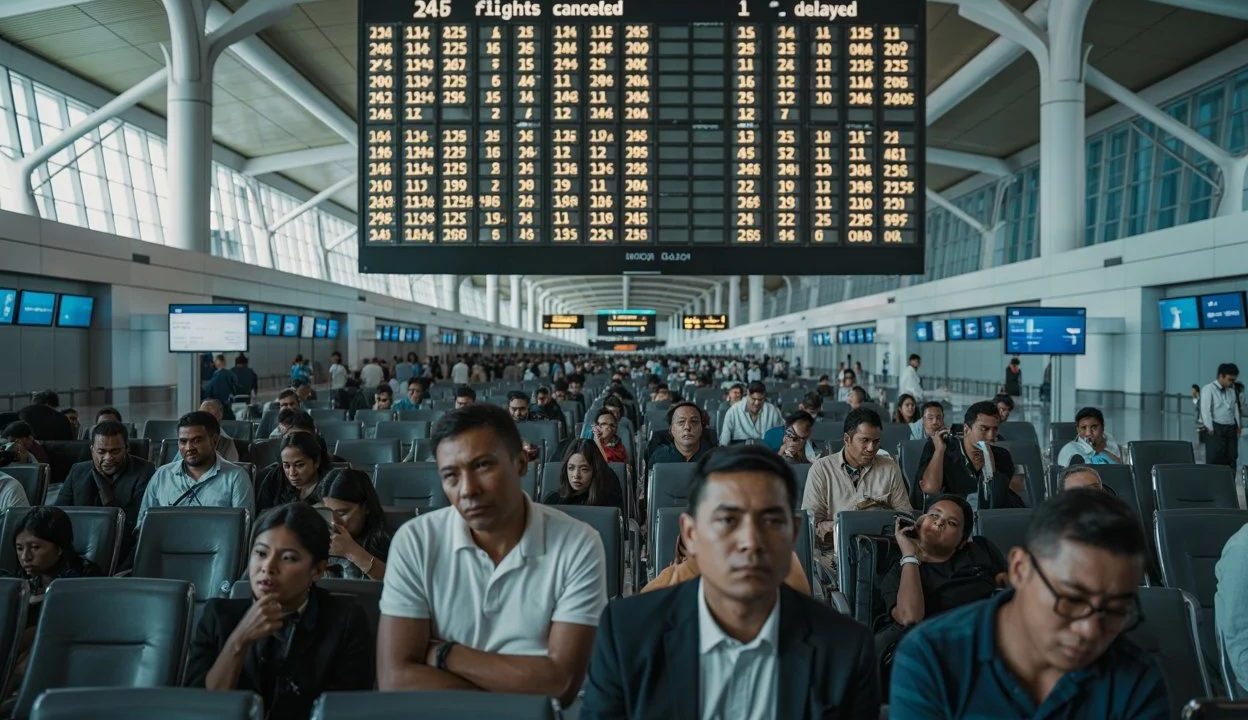
Priya Mehta was supposed to be home in Mumbai by now, sharing dinner with her family after a successful business trip to Manama. Instead, she found herself sleeping on an airport chair for the second night, her phone buzzing with worried messages from relatives she couldn’t reach.

“I’ve traveled this route dozens of times,” she said, staring at the departure board showing yet another canceled flight. “I’ve never seen anything like this.”
Priya isn’t alone. She’s one of hundreds of travelers currently stranded at Bahrain International Airport as an unprecedented airspace closure has grounded 172 flights, creating one of the most significant travel disruptions the Gulf region has seen in years.

What’s Really Happening in Bahrain’s Skies
The situation unfolded rapidly when Bahrain authorities made the decision to close portions of their airspace, sending shockwaves through the region’s carefully orchestrated flight network. Major carriers including Gulf Air, Qatar Airways, Emirates, and Etihad Airways found themselves scrambling to manage the fallout.
The timing couldn’t have been worse. This closure affects some of the busiest routes in the Middle East, connecting travelers to Dubai, Doha, Abu Dhabi, and beyond. These aren’t just tourist destinations – they’re critical business hubs that thousands of professionals, families, and travelers depend on daily.

This type of widespread closure creates a domino effect that ripples across the entire Gulf aviation network. When Bahrain closes its airspace, it doesn’t just affect flights to and from Bahrain – it impacts the entire regional flow.
— Ahmed Al-Rashid, Aviation Industry Analyst

The closure has forced airlines to make difficult decisions about rerouting, refueling, and managing passenger expectations. Some flights are being diverted to alternative airports, while others are simply canceled outright.
The Numbers Tell a Stark Story
Let’s break down exactly what 172 canceled flights means for real people:
| Airline | Affected Routes | Estimated Passengers |
|---|---|---|
| Gulf Air | Dubai, Doha, Kuwait | 8,500+ |
| Qatar Airways | Doha, Abu Dhabi | 6,200+ |
| Emirates | Dubai, connecting flights | 4,800+ |
| Etihad Airways | Abu Dhabi, regional routes | 3,100+ |
| Other carriers | Various destinations | 2,400+ |
These aren’t just statistics – they represent:
- Business executives missing crucial meetings and deals
- Families separated during important celebrations
- Medical patients unable to reach specialized treatment
- Students trying to return to universities across the region
- Workers whose livelihoods depend on timely travel
We’re seeing people who booked connecting flights through Bahrain now stuck for days. Some have missed weddings, job interviews, and medical appointments. The human cost goes far beyond just inconvenience.
— Fatima Al-Zahra, Passenger Rights Advocate
How This Affects Your Travel Plans
If you’re planning to travel through the Gulf region in the coming weeks, this situation should definitely be on your radar. The ripple effects are already being felt across multiple airports and airlines.
Here’s what you need to know right now:
Airlines are struggling to accommodate the sudden influx of displaced passengers. Hotel rooms near Bahrain International Airport are completely booked, forcing some travelers to sleep in the terminal or seek accommodation far from the airport.
The financial impact is staggering too. Each canceled flight costs airlines thousands of dollars in fuel, crew scheduling, and passenger compensation. But for travelers, the costs are more personal – missed connections, emergency hotel bookings, and unexpected meal expenses.
What we’re seeing is a stress test of the Gulf’s aviation infrastructure. Bahrain serves as a crucial hub, and when it goes down, the entire network feels the pressure.
— Captain Hassan Al-Mansoori, Former Gulf Air Pilot
Some passengers are getting creative with alternative routes. Instead of flying directly to Dubai, some are taking buses to Saudi Arabia and flying from there. Others are booking expensive last-minute tickets on unaffected carriers, even if it means paying three times the normal fare.
What Airlines Are Doing to Help
To their credit, most major carriers are trying to minimize passenger suffering. Gulf Air has set up emergency accommodation for stranded passengers, while Qatar Airways is offering flexible rebooking options without additional fees.
Emirates has deployed larger aircraft on alternative routes to absorb some of the displaced passengers, though this solution only helps a fraction of those affected.
The airlines are also coordinating with each other in ways that don’t usually happen. Competitors are honoring each other’s tickets and sharing passenger loads to get people moving again.
In situations like this, the industry has to work together. We may compete for customers, but we all understand that stranded passengers need solutions, regardless of which airline they originally booked with.
— Rania Khalil, Airline Operations Manager
Looking Ahead: When Will This End?
The big question everyone’s asking is how long this will last. Unfortunately, airspace closures of this magnitude don’t have predictable timelines. The decision to reopen depends on factors that airlines and passengers have no control over.
What we do know is that when the airspace does reopen, it won’t mean immediate relief. Airlines will need time to reposition aircraft, reschedule crews, and work through the backlog of stranded passengers.
Travel experts suggest that even after the closure ends, it could take 3-5 days for flight schedules to return to normal. That means if you have travel plans in the Gulf region for the next week, you should definitely have backup plans ready.
For now, hundreds of travelers like Priya continue to wait, hoping that tomorrow will bring better news and a chance to finally get home.
FAQs
How long will the Bahrain airspace closure last?
There’s no official timeline yet. Airspace closures depend on various factors, and authorities haven’t announced when normal operations will resume.
Will airlines compensate passengers for canceled flights?
Most major airlines are offering rebooking without fees and covering accommodation for stranded passengers, though specific compensation varies by carrier and ticket type.
Can I get a refund if my flight was canceled?
Yes, passengers are typically entitled to full refunds for canceled flights, though airlines may also offer travel credits or rebooking options.
Are there alternative routes to reach Dubai or Doha?
Yes, some travelers are using overland routes to Saudi Arabia or Kuwait and flying from there, though this adds significant time and cost to the journey.
Should I avoid booking flights through Bahrain right now?
Until the situation stabilizes, it may be wise to choose alternative routes or wait for official confirmation that normal operations have resumed.
What should I do if I’m currently stranded at Bahrain International Airport?
Contact your airline immediately for rebooking options, keep all receipts for unexpected expenses, and consider reaching out to your travel insurance provider if applicable.

Leave a Reply