
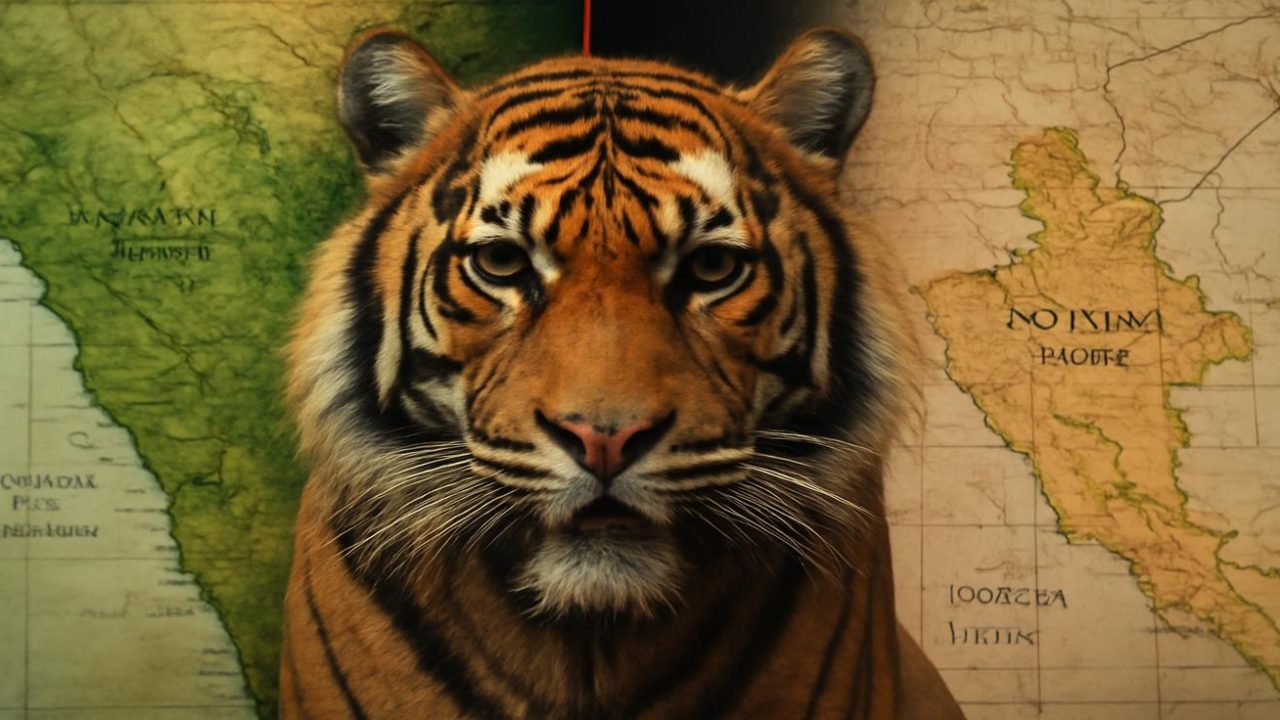
Dr. Ananda Kartika pressed her back against the massive dipterocarp tree, its ancient bark rough against her field jacket. After three decades studying Sumatran tigers, she had never felt this helpless. Through her binoculars, she watched as bulldozers carved another gaping wound through what used to be pristine rainforest. “Twenty years ago, this was all green,” she whispered to her research assistant. “Now look at it.”
The numbers that flashed across her tablet screen told a story more devastating than any horror film. Kerinci Seblat National Park—the last stronghold for critically endangered Sumatran tigers—had lost nearly 50% of its forest cover in just two decades.
What Dr. Kartika witnessed that morning represents one of the most catastrophic environmental disasters happening right now, yet most of the world remains unaware. While we scroll through social media and worry about daily life, an entire subspecies of tiger is being erased from existence.
The Shocking Reality Behind Indonesia’s Crown Jewel
Kerinci Seblat National Park spans across four Indonesian provinces and covers roughly 13,750 square kilometers. It’s supposed to be a protected sanctuary—the kind of place where Sumatran tigers can hunt, mate, and raise cubs without human interference.
Instead, satellite imagery reveals a landscape that looks more like Swiss cheese than a national park. Illegal palm oil plantations, coffee farms, and logging operations have carved up the forest into fragments too small to support tiger populations.
The rate of deforestation we’re seeing is unprecedented. We’re losing tiger habitat faster than the animals can adapt or relocate.
— Dr. Matthew Luskin, Wildlife Conservation Researcher
The Sumatran tiger population has plummeted to fewer than 400 individuals in the wild. That’s not 400,000 or even 4,000—just 400 tigers left on the entire planet. Each bulldozer that enters the park potentially sentences another tiger family to death.
What makes this crisis even more heartbreaking is how preventable it is. Unlike climate change or natural disasters, deforestation is a human choice. Every tree that falls is cut down by someone who decided short-term profit mattered more than species survival.
Breaking Down the Destruction: What the Data Shows
Recent analysis using advanced satellite technology has revealed the devastating scope of forest loss within what should be Indonesia’s most protected tiger habitat:
| Time Period | Forest Area Lost | Remaining Tiger Population | Primary Cause |
|---|---|---|---|
| 2000-2005 | 12% | ~800 tigers | Logging operations |
| 2005-2010 | 18% | ~600 tigers | Palm oil expansion |
| 2010-2015 | 15% | ~500 tigers | Agricultural conversion |
| 2015-2020 | 8% | ~400 tigers | Infrastructure development |
The destruction isn’t random—it follows a predictable pattern that makes conservation efforts nearly impossible:
- Road construction opens previously inaccessible forest areas
- Selective logging removes the largest, most valuable trees
- Agricultural clearing eliminates understory vegetation
- Palm oil plantations replace diverse ecosystems with monoculture
- Human settlements fragment remaining forest patches
We’re not just losing trees. We’re losing an entire ecosystem that took millions of years to develop. Once it’s gone, it’s gone forever.
— Dr. Rona Dennis, Tropical Forest Specialist
The most disturbing aspect of this data is the acceleration. While the percentage of annual loss has decreased recently, that’s only because there’s less forest left to destroy. The absolute impact on remaining tigers has actually intensified.
Why This Matters Beyond Tigers
When most people hear about endangered tigers, they think it’s sad but not personally relevant. That’s a dangerous misconception. The collapse of Kerinci Seblat’s ecosystem affects everyone on the planet in ways you might not expect.
Sumatran tigers are what biologists call an “umbrella species.” Protecting enough habitat for tigers automatically protects hundreds of other species that share the same ecosystem. Lose the tigers, and you lose orangutans, elephants, rhinoceros, and thousands of plant species that could hold keys to medical breakthroughs.
The economic impact extends far beyond Indonesia’s borders. Forest destruction releases massive amounts of stored carbon into the atmosphere, accelerating climate change. The same weather disruptions that cause flooding in Europe and droughts in California can be traced back to deforestation in places like Kerinci Seblat.
Every hectare of Indonesian rainforest that disappears makes extreme weather events more likely everywhere else in the world.
— Dr. James Hansen, Climate Research Institute
Local communities suffer the most immediate consequences. Indigenous people who have lived sustainably in these forests for generations are being displaced. Traditional knowledge about medicinal plants and sustainable hunting practices disappears along with the trees.
Tourism revenue—which could provide sustainable long-term income—evaporates when there are no longer any tigers to see. Countries like India and Nepal have proven that tiger tourism can generate millions of dollars annually while protecting ecosystems.
What Happens When the Last Tiger Dies
Scientists have modeled what Sumatra will look like if current deforestation trends continue. The results are sobering. Within the next decade, Kerinci Seblat National Park could lose its status as a protected area simply because there won’t be anything left to protect.
The ripple effects would be felt immediately. Without top predators, prey animal populations would explode, then crash as they exceed the carrying capacity of remaining forest fragments. Plant communities would shift dramatically as seed dispersers disappear.
We’re conducting a massive ecological experiment with no control group and no way to reverse the results.
— Dr. Erik Meijaard, Conservation Biologist
But perhaps the most tragic aspect is how easily this disaster could still be prevented. Unlike extinct species such as passenger pigeons or Tasmanian tigers, Sumatran tigers still exist. There’s still time—but that window is closing rapidly.
International pressure, sustainable financing for local communities, and strict enforcement of existing laws could halt deforestation within months. The technology exists, the legal framework exists, and the global awareness is finally building.
What’s missing is the political will to treat this crisis with the urgency it deserves. While politicians debate and corporations delay, the chainsaws keep running. Every day we wait, another piece of irreplaceable forest disappears forever.
FAQs
How many Sumatran tigers are left in the wild?
Fewer than 400 individuals remain, making them one of the world’s most critically endangered subspecies.
What is the main cause of forest loss in Kerinci Seblat National Park?
Illegal palm oil plantations and agricultural conversion are the primary drivers, followed by logging and infrastructure development.
Can the forest grow back if deforestation stops?
Tropical rainforests can regenerate, but it takes 50-100 years to restore the complex ecosystem that tigers need to survive.
Why don’t tigers just move to other forests?
Tigers need large territories with adequate prey populations. Remaining forest fragments are too small and isolated to support viable tiger populations.
What can people outside Indonesia do to help?
Support organizations working on tiger conservation, avoid products containing unsustainable palm oil, and pressure governments to enforce international wildlife protection agreements.
How much would it cost to save the remaining forest?
Conservation experts estimate that $50-100 million annually could fund effective protection and alternative livelihoods for local communities—less than many countries spend on a single military aircraft.

Leave a Reply