
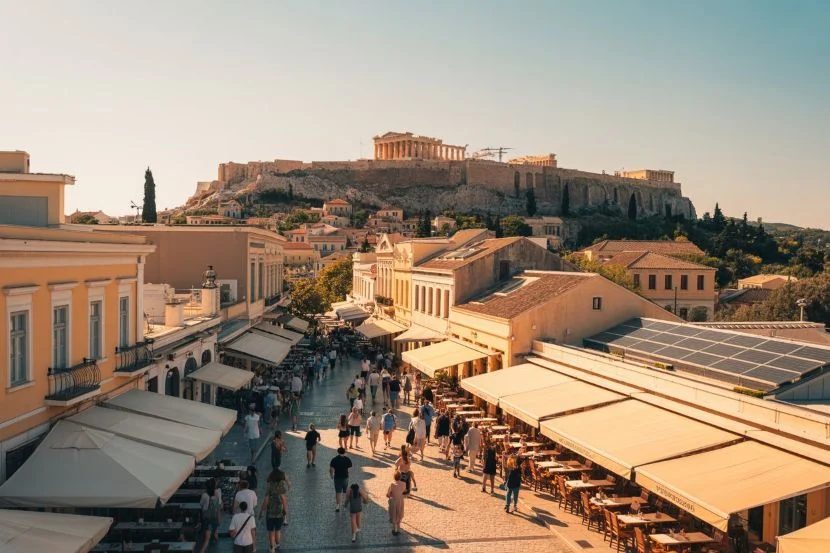
Dimitrios wiped the sweat from his brow as he adjusted the solar panel on his family’s centuries-old taverna overlooking the Aegean Sea. “My grandfather would laugh,” he chuckled to his wife, watching the digital display show their energy meter running backward for the first time ever. “We’re actually selling power back to the grid now.”

What seemed impossible just five years ago has become Greece’s new reality. The country that once symbolized economic struggle is now leading Europe’s clean energy revolution, transforming everything from ancient archaeological sites to remote island communities into showcases of sustainable tourism.
This isn’t just about saving the planet—it’s about saving Greece’s most precious asset: its unparalleled beauty that draws millions of visitors each year.
Greece’s Green Energy Transformation is Rewriting the Tourism Playbook
The numbers tell an incredible story. Greece has increased its renewable energy capacity by over 60% since 2019, with wind and solar installations now powering everything from luxury resorts to traditional fishing villages. But here’s what makes this different from other destinations: Greece isn’t just going green—it’s doing it without sacrificing the authentic charm that makes it magical.
Walk through Mykonos today and you’ll see windmills—both the iconic traditional ones and sleek modern turbines—working in harmony. The contrast isn’t jarring; it’s inspiring. Local authorities have mandated that new renewable installations complement, rather than compete with, the landscape that tourists come to see.

We realized early on that sustainability and authenticity aren’t opposites—they’re partners. Our visitors want to feel good about their impact while experiencing genuine Greek culture.
— Elena Papadakis, Greek Tourism Board Sustainability Director

The Acropolis itself now runs entirely on renewable energy, with nearly invisible solar installations integrated into visitor facilities. Even the lighting that illuminates the Parthenon at night comes from clean sources, ensuring this 2,500-year-old wonder will be preserved for future generations.
Island by Island: How Greece is Building the World’s First Fully Sustainable Archipelago
The real magic is happening on Greece’s islands, where isolation once meant energy dependence and high costs. Now, that same isolation has become an advantage, allowing entire communities to experiment with cutting-edge clean technology.
Here’s how different islands are leading the charge:
- Tilos: First Greek island to achieve energy independence through wind and solar power
- Astypalea: Partnering with Volkswagen to become Europe’s first smart, sustainable island
- Chalki: Testing floating solar farms and advanced battery storage systems
- Symi: Converting traditional fishing boats to electric while maintaining their classic appearance
- Folegandros: Using geothermal energy to power desalination plants, ensuring fresh water sustainability
| Island | Population | Renewable Energy % | Key Innovation |
|---|---|---|---|
| Tilos | 780 | 95% | Wind-solar hybrid system |
| Astypalea | 1,300 | 80% | Smart grid integration |
| Chalki | 330 | 100% | Floating solar arrays |
| Symi | 2,500 | 70% | Marine energy capture |
When I first proposed electric fishing boats, the old-timers thought I was crazy. Now they’re the first to brag about silent morning fishing trips and zero fuel costs.
— Nikos Stavros, Symi Harbor Master
The transformation goes beyond just power generation. Hotels are installing smart systems that automatically adjust air conditioning based on occupancy and weather. Restaurants are using solar-powered refrigeration that keeps traditional Greek dishes fresh without the constant hum of old diesel generators.
What This Means for Your Next Greek Adventure
As a traveler, you’ll notice the difference immediately. The air is cleaner, the nights are quieter, and somehow everything feels more… Greek. Without the constant noise and pollution of diesel generators, you can actually hear the waves lapping against ancient harbor walls and the evening calls of seabirds.
Your accommodation costs are dropping too. Hotels powered by renewable energy are passing savings directly to guests, with many offering “green stay” discounts of 15-20% for visitors who choose sustainable options.
The food tastes better when restaurants can maintain perfect refrigeration temperatures using consistent solar power instead of rationing diesel fuel. Local fishermen using electric boats report that fish populations are recovering in harbors no longer polluted by fuel runoff.
My guests used to complain about generator noise during afternoon naps. Now they tell me our terrace has the most peaceful sunset views in the Mediterranean.
— Andreas Kostas, Boutique Hotel Owner, Folegandros
Adventure activities are expanding too. Electric boat tours can approach wildlife without frightening animals away with engine noise. Hiking trails feature solar-powered emergency stations and water refill points. Even traditional activities like olive oil pressing now showcase how ancient techniques work perfectly with modern clean energy.
The Ripple Effect Across the Mediterranean
Other destinations are taking notice, but Greece’s head start is significant. While competitors are still debating renewable energy policies, Greek islands are already living the sustainable tourism future.
The economic impact extends far beyond energy savings. Clean technology jobs are keeping young Greeks on their home islands instead of migrating to Athens or abroad. Traditional craftsmen are finding new markets creating custom solar panel frames that match historic architecture.
We’re not just preserving our past—we’re ensuring our future. My son can now imagine building a life here instead of leaving for the city.
— Maria Alexandrou, Local Artisan, Tilos
International recognition is following the results. Greece recently won the EU’s Sustainable Tourism Excellence Award and is hosting the 2024 Mediterranean Clean Energy Summit. Tourism bookings are up 40% year-over-year, with “eco-conscious” travelers specifically seeking out Greek destinations.
The transformation proves that environmental responsibility and tourism growth aren’t mutually exclusive. Greece is demonstrating that the most sustainable path forward might also be the most profitable one.
FAQs
How much can I save on accommodation by choosing green hotels in Greece?
Most sustainable hotels offer 15-20% discounts, and you’ll save additional money on activities since many now run on cheaper renewable energy.
Are the traditional Greek experiences still authentic with all this new technology?
Absolutely. The technology is designed to enhance, not replace, traditional experiences. You’ll still find authentic tavernas and local customs, just powered more sustainably.
Which Greek islands are the most advanced in renewable energy?
Tilos, Astypalea, and Chalki are leading the way, but most islands now have significant renewable energy infrastructure.
Is transportation between islands becoming more sustainable too?
Yes, several ferry companies are introducing hybrid and electric vessels, and inter-island flights are increasingly using sustainable aviation fuels.
Will this green transformation increase tourism prices overall?
Actually, the opposite is happening. Lower energy costs are reducing operational expenses, making Greece more competitive with other Mediterranean destinations.
How reliable is renewable energy on remote Greek islands?
Very reliable. Most islands now have advanced battery storage systems and backup renewable sources, making power more consistent than the old diesel generators.

Leave a Reply