
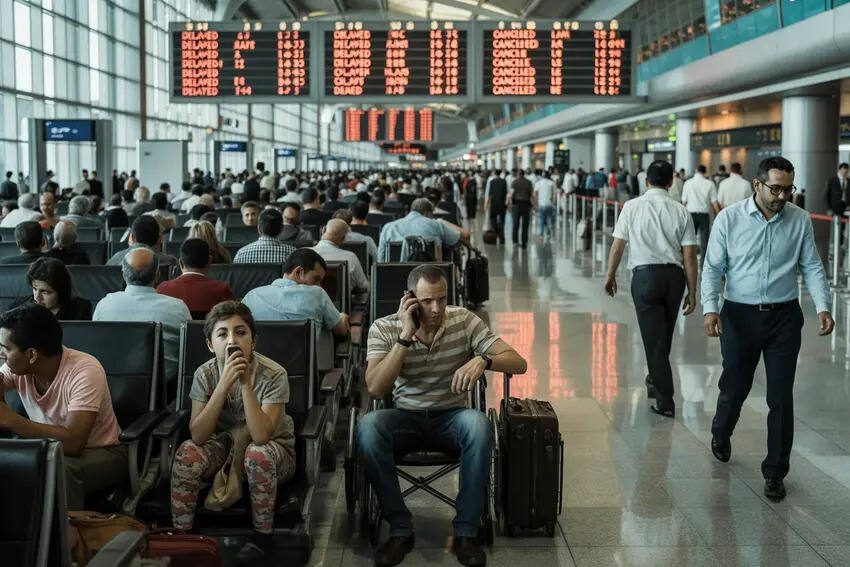
Amara stared at the departure board in Dubai International Airport, watching her flight status change from “Delayed” to “Cancelled” for the third time in two days. The 34-year-old architect from London had been trying to get home after a business conference, but like thousands of other travelers, she found herself trapped in what’s becoming the Middle East’s worst aviation crisis in recent memory.

“I’ve slept on these airport chairs longer than I spent at my actual hotel,” she told another stranded passenger while scrolling through rebooking options that seemed to disappear as quickly as they appeared. Her story isn’t unique—it’s being repeated across major airports throughout the region as a perfect storm of disruptions brings air travel to its knees.
A Region-Wide Aviation Nightmare Unfolds
The numbers are staggering: 1,161 flight delays and 1,014 cancellations have created chaos across the Middle East’s busiest aviation hubs. What started as isolated incidents has snowballed into a crisis affecting major carriers including Emirates, Qatar Airways, Gulf Air, and Saudia.

The disruption spans multiple countries, with Saudi Arabia, the UAE, Turkey, Qatar, and Jordan all reporting significant operational challenges. Key airports in Dubai, Istanbul, Doha, and Abu Dhabi—normally models of efficiency—are struggling to manage the surge of displaced passengers and rescheduled flights.
This is unlike anything we’ve seen in the region since the early days of the pandemic. The interconnected nature of Middle Eastern aviation means when one hub struggles, the ripple effects are immediate and severe.
— Dr. Hassan Al-Rashid, Aviation Industry AnalystAlso Read Malaysia’s Royal Town Unveils 2026 Festival That Could Transform Heritage Tourism Forever
The timing couldn’t be worse. The Middle East serves as a crucial connecting point between Europe, Asia, and Africa, making these disruptions global in scope. Business travelers, tourists, and residents alike find themselves caught in an increasingly complex web of rebookings and extended delays.

Breaking Down the Crisis by the Numbers
The scale of disruption becomes clearer when you examine the data across affected regions. Here’s how the crisis is impacting different areas:
| Country/Region | Delays | Cancellations | Most Affected Airlines |
|---|---|---|---|
| UAE | 387 | 298 | Emirates, Etihad Airways |
| Saudi Arabia | 264 | 201 | Saudia, Flynas |
| Qatar | 198 | 187 | Qatar Airways |
| Turkey | 156 | 143 | Turkish Airlines |
| Jordan | 89 | 102 | Royal Jordanian |
| Other Regional | 67 | 83 | Gulf Air, Kuwait Airways |
The disruption patterns reveal several troubling trends:

- Peak travel routes between major business centers are seeing 40-60% of flights affected
- Connection flights face longer delays due to missed transfer windows
- Regional airlines are struggling more than international carriers with recovery times
- Weekend flights show higher cancellation rates than weekday services
- Business class passengers report slightly better rebooking success rates
We’re seeing a cascading effect where delays in one city create problems three destinations away. The hub-and-spoke model that usually works so well for the region is now working against us.
— Captain Farid Mansouri, Former Commercial Pilot
What’s Really Behind This Travel Chaos
Multiple factors have converged to create this unprecedented situation. Air traffic control limitations, severe weather patterns, and operational staffing challenges are all playing roles, but the underlying issue runs deeper.
The region’s airports, designed to handle massive passenger volumes efficiently, are discovering that their interconnected nature becomes a vulnerability when multiple stress points hit simultaneously. A sandstorm in Riyadh doesn’t just affect Saudi flights—it impacts connections throughout the Gulf.
Technical infrastructure problems have compounded the crisis. Several airports report issues with baggage handling systems, gate assignment software, and passenger communication platforms. When these systems fail during peak disruption periods, the recovery process slows dramatically.
The Middle East built its aviation success on precision timing and seamless connections. When that precision breaks down, the recovery is much more complex than in point-to-point airline markets.
— Sarah Mitchell, International Aviation Consultant
The Human Cost of Grounded Dreams
Behind every cancelled flight statistic is a human story. Business deals falling through, family reunions postponed, medical appointments missed, and vacation plans destroyed. Hotels near major airports report 200-300% occupancy rates as travelers extend stays indefinitely.
The financial impact extends beyond airline compensation. Travelers report spending hundreds of dollars on extended hotel stays, meal vouchers that don’t cover actual costs, and premium rebooking fees for alternative routes. Travel insurance claims in the region have spiked 400% in the past week.
Families traveling with children face particular challenges. Airport sleeping areas, not designed for extended stays, lack basic amenities for young travelers. Parents describe the stress of managing tired, confused children while navigating constantly changing departure information.
We’re seeing travelers who’ve been rerouted three or four times, sometimes through completely different continents just to reach their original destination. The emotional toll is as significant as the financial one.
— Ahmad Khalil, Passenger Rights Advocate
What Travelers Can Do Right Now
If you’re planning travel through the Middle East or currently stranded, here are immediate steps that can help:
- Download airline apps and enable push notifications for real-time updates
- Consider alternative routing through European or Asian hubs, even if longer
- Document all expenses related to delays for compensation claims
- Join airline loyalty programs immediately—members get priority rebooking
- Contact travel insurance providers early in the delay process
- Book refundable hotel rooms near airports as backup plans
The recovery timeline remains uncertain. While airlines promise improved operations within days, industry experts suggest travelers should prepare for continued disruptions throughout the coming weeks. The complexity of rebooking thousands of displaced passengers means the effects will linger long after the initial causes are resolved.
FAQs
How long will these flight disruptions in the Middle East continue?
Airlines estimate 7-14 days for full recovery, but ongoing effects could last several weeks as the backlog clears.
Am I entitled to compensation for these delays and cancellations?
Compensation depends on your airline, route, and cause of disruption. EU and UK passengers have stronger protection rights than others.
Should I cancel my upcoming Middle East travel plans?
Monitor your specific route and airline. Consider flexible booking options and travel insurance if proceeding with plans.
Which Middle East airports are least affected right now?
Smaller regional airports show fewer disruptions, but they also have limited rebooking options and fewer alternative flights.
Can I get refunds instead of rebooking on affected flights?
Most airlines offer full refunds for cancelled flights, though processing times may be longer than usual during this crisis.
What’s the best way to reach customer service during this chaos?
Use airline social media channels and mobile apps rather than phone lines, which are overwhelmed with call volumes.

Leave a Reply